

KCEX Futures Trading FAQ: Common Questions About Perpetual Futures, Funding Rates, Liquidation Prices, and Trading Fees
2026-09-03 20:05:59
This article addresses common questions about KCEX futures trading, including what perpetual futures are, index prices and mark prices, futures trading fees, funding rates, futures profit and loss and liquidation price calculations, as well as possible reasons why take-profit and stop-loss, trigger, and trailing stop orders may fail to trigger. It is designed to help you quickly understand the KCEX perpetual futures trading mechanism and related frequently asked questions.
1. What Are Perpetual Futures?
Perpetual futures are a type of cryptocurrency derivative similar to leveraged spot trading. By anticipating price movements, you can choose to go long (buy) or go short (sell) and potentially profit from increases or decreases in digital asset prices.
Unlike traditional futures, perpetual futures have no fixed delivery or expiration date. Instead, they use funding rates to track the index price. To learn more, please refer to the Introduction to KCEX Perpetual Futures.
2. What Is the Index Price?
The index price is the weighted average price of the underlying asset across major spot exchanges. It reflects the actual market value of the futures and is continuously updated as the spot price of the underlying asset changes.
The index price serves two main purposes:
(1) It limits the maximum buy price and minimum sell price for order placement, preventing the futures price from deviating significantly from the spot market.
(2) It serves as one of the factors used to calculate the mark price.
3. What Is the Mark Price?
The mark price is calculated using the index price, funding rate, order book prices, and latest execution price. It provides a more accurate representation of the true value of the futures and is an important pricing mechanism designed to maintain market stability and reduce unnecessary liquidations during abnormal market volatility.
The mark price is primarily used to determine liquidations and calculate unrealized profit and loss. It can effectively prevent unnecessary deviations between the order book price and the index price caused by market manipulation or insufficient liquidity, thereby reducing unnecessary liquidations. The mark price is a core risk-control mechanism designed by KCEX to protect traders.
4. How Can I Check the Futures Fee Rates and My Paid Trading Fee Records?
KCEX is committed to building a futures trading platform with the lowest fee rates. Maker traders enjoy a 0% fee rate. For details, please refer to Trading Fees.
You can view the specific fee rate for the current trading pair below the order placement section on the futures trading page.

You can click “Fund Records” and select “Trading Fee” to view all trading fee records.
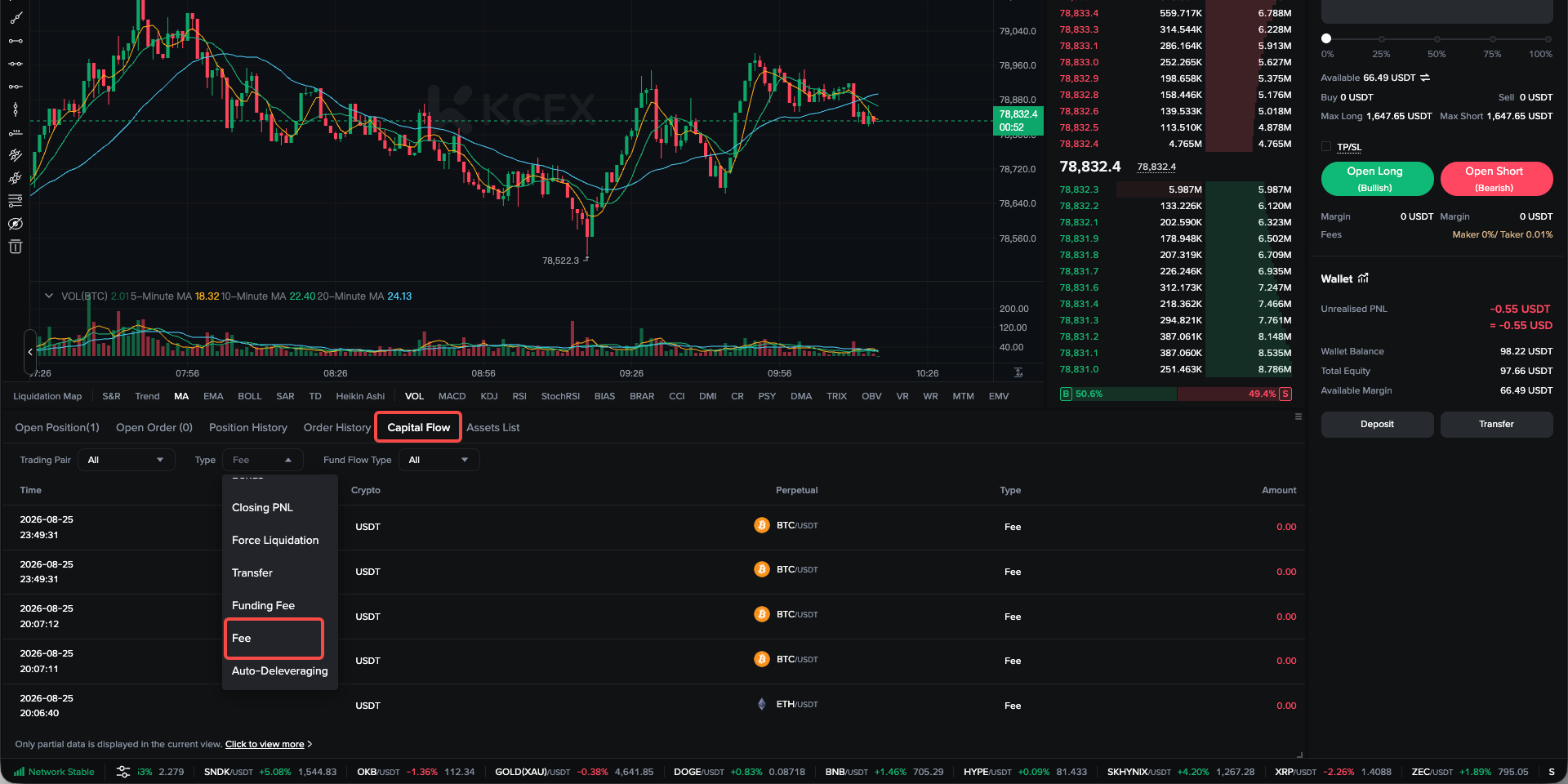
5. What Is the Funding Rate?
The funding rate is a mechanism unique to perpetual futures. Its purpose is to keep the futures price anchored to the spot price and prevent persistent price deviations.
Based on the price difference between perpetual futures and the spot market, the platform calculates a funding rate. Long and short traders periodically pay funding fees to one another according to the funding rate. KCEX does not charge any fees from these payments.
- When the market trend is bullish, the funding rate is positive, and long traders pay funding fees to short traders.
- When the market trend is bearish, the funding rate is negative, and short traders pay funding fees to long traders.
Funding fee calculation formula:
Funding Fee = Position Quantity at the Snapshot Time × Mark Price × Funding Rate
To learn more about funding rates, please refer to the Futures Funding Rate Mechanism.
6. How Is Futures Profit and Loss Calculated?
Closed P&L formulas:
Long Position = (Closing Price − Average Entry Price) × Executed Quantity (Coin)
Short Position = (Average Entry Price − Closing Price) × Executed Quantity (Coin)
Unrealized P&L formulas:
Long Position = (Mark Price − Average Entry Price) × Position Quantity (Coin)
Short Position = (Average Entry Price − Mark Price) × Position Quantity (Coin)
7. How Is the Liquidation Price Calculated?
The liquidation price is calculated based on the following condition:
Position Margin + Unrealized P&L ≤ Maintenance Margin
Excluding trading fees, the specific calculations are as follows:
Long Position:
Liquidation Price = (Maintenance Margin − Position Margin + Average Entry Price × Position Quantity (Coin)) ÷ Position Quantity (Coin)
Short Position:
Liquidation Price = (Average Entry Price × Position Quantity (Coin) − Maintenance Margin + Position Margin) ÷ Position Quantity (Coin)
For more information, please refer to Liquidation and Risk Management.
8. Why Do Take-Profit and Stop-Loss, Trigger, and Trailing Stop Orders Fail to Trigger?
Take-profit and stop-loss, trigger, and trailing stop orders are all strategy orders. They do not freeze the user’s margin when placed. Only when the specified conditions are met will the system submit the corresponding limit or market order. If the order cannot be placed at that time for any reason, the strategy order will fail to trigger.
Therefore, these three types of orders are not guaranteed to trigger successfully. They may fail for the following reasons:
- Insufficient liquidity: No counterparty is available to execute the order at the specified price.
- Insufficient margin: The account has insufficient available balance when the order is triggered.
- Futures trading is suspended: The futures are under maintenance or trading has been suspended when the order is triggered.
- Position limit reached: If the triggered order is intended to open a position, the position quantity limit may already have been reached.
- Recommendation: Trade major cryptocurrencies with sufficient liquidity.
9. Why Am I Unable to Increase My Position Size Despite Having Sufficient Available Margin?
This usually occurs because the position quantity limit has been reached. To reduce the risk of significant losses caused by the liquidation of a single large, highly leveraged position during periods of extreme market volatility, KCEX uses a position tier mechanism.
The system applies tiered margin requirements for risk control. The higher the leverage, the lower the maximum allowable position size. In addition, the larger the position, the higher the maintenance margin rate.
You can view the maximum position quantity available for the same futures under different tiers by going to “Futures Information” – “Position Tiers.”
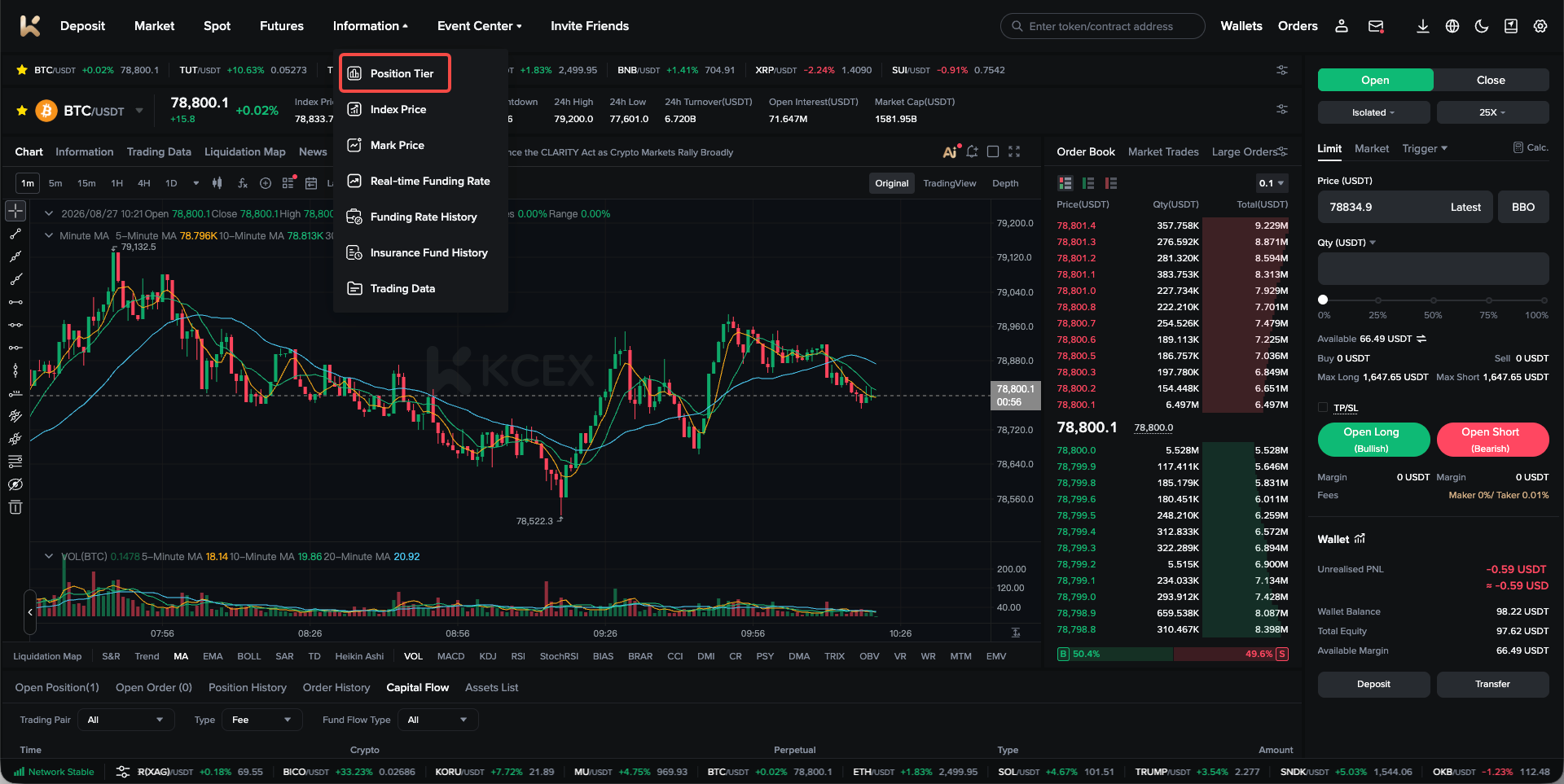
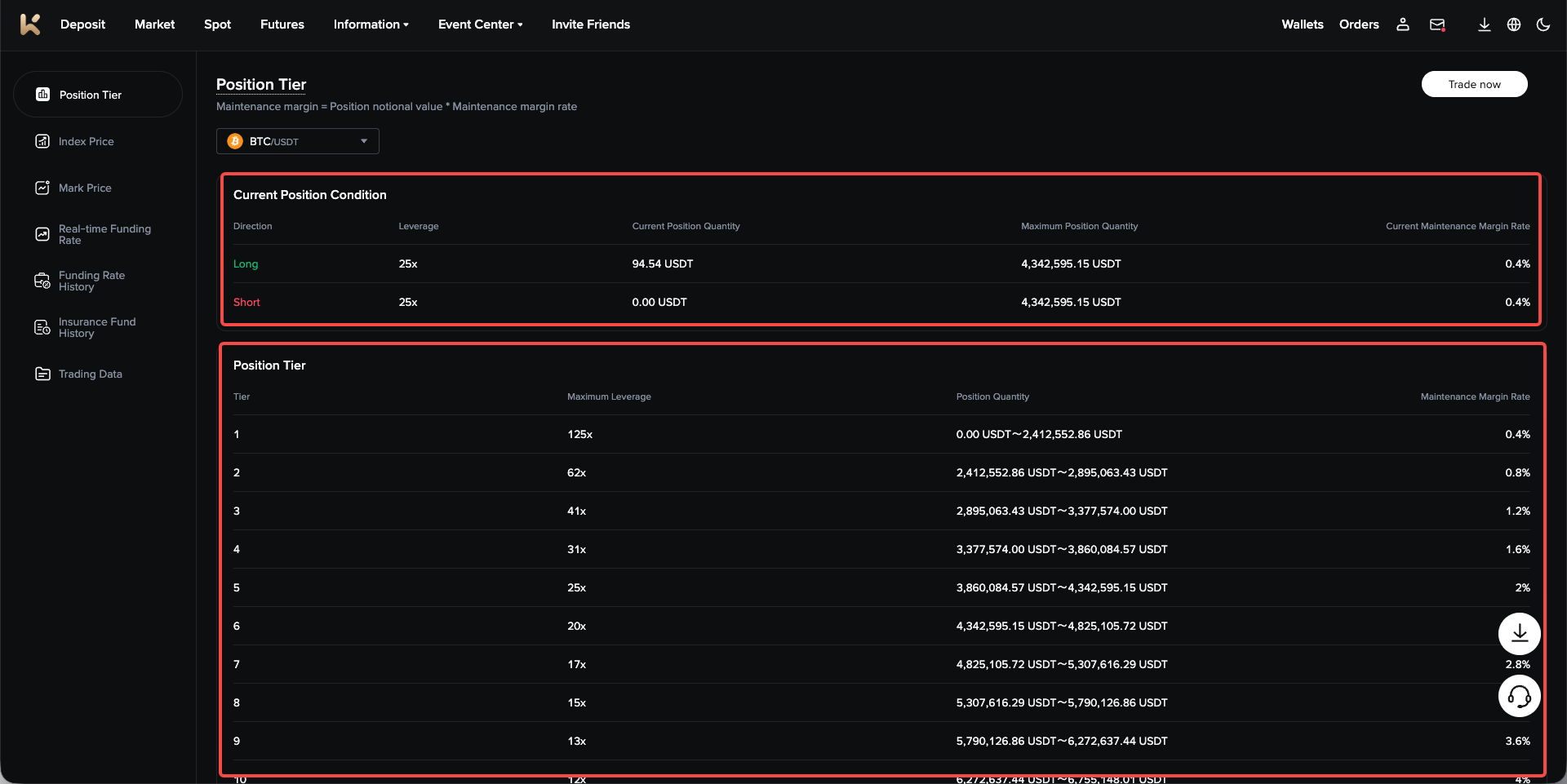
To learn more, please refer to Liquidation and Position Tiers.
KCEX remains committed to providing users with safe and efficient futures trading services. Thank you for your support!