

KCEX Futures Liquidation FAQ: Liquidation Price, Bankruptcy Price, and Stop-Loss Order Failures
2026-08-25 20:15:55
Liquidation, also commonly referred to as a position being liquidated, is an important risk control mechanism in perpetual futures trading. When a position’s margin ratio reaches the liquidation threshold, the system will take over and process the position in accordance with the applicable rules. This article addresses frequently asked questions about KCEX futures liquidation, including the liquidation trigger conditions, the relationship between mark price and liquidation, the difference between liquidation price and bankruptcy price, changes in liquidation prices under cross-margin and isolated-margin modes, the impact of funding fees, and stop-loss order failures. It is intended to help you better understand the futures liquidation mechanism and its associated risks.
1. What Is Liquidation?
Liquidation occurs when a user’s position reaches the liquidation threshold and the platform takes over and closes the position. On KCEX, a position’s margin ratio is used to assess its risk level and serves as an indicator of the risk to the user’s assets. When the margin ratio reaches or exceeds 100%, the system will liquidate the user’s position. Users are advised to monitor changes in their margin ratio closely to reduce the risk of liquidation.
2. Relationship Between Mark Price and Liquidation
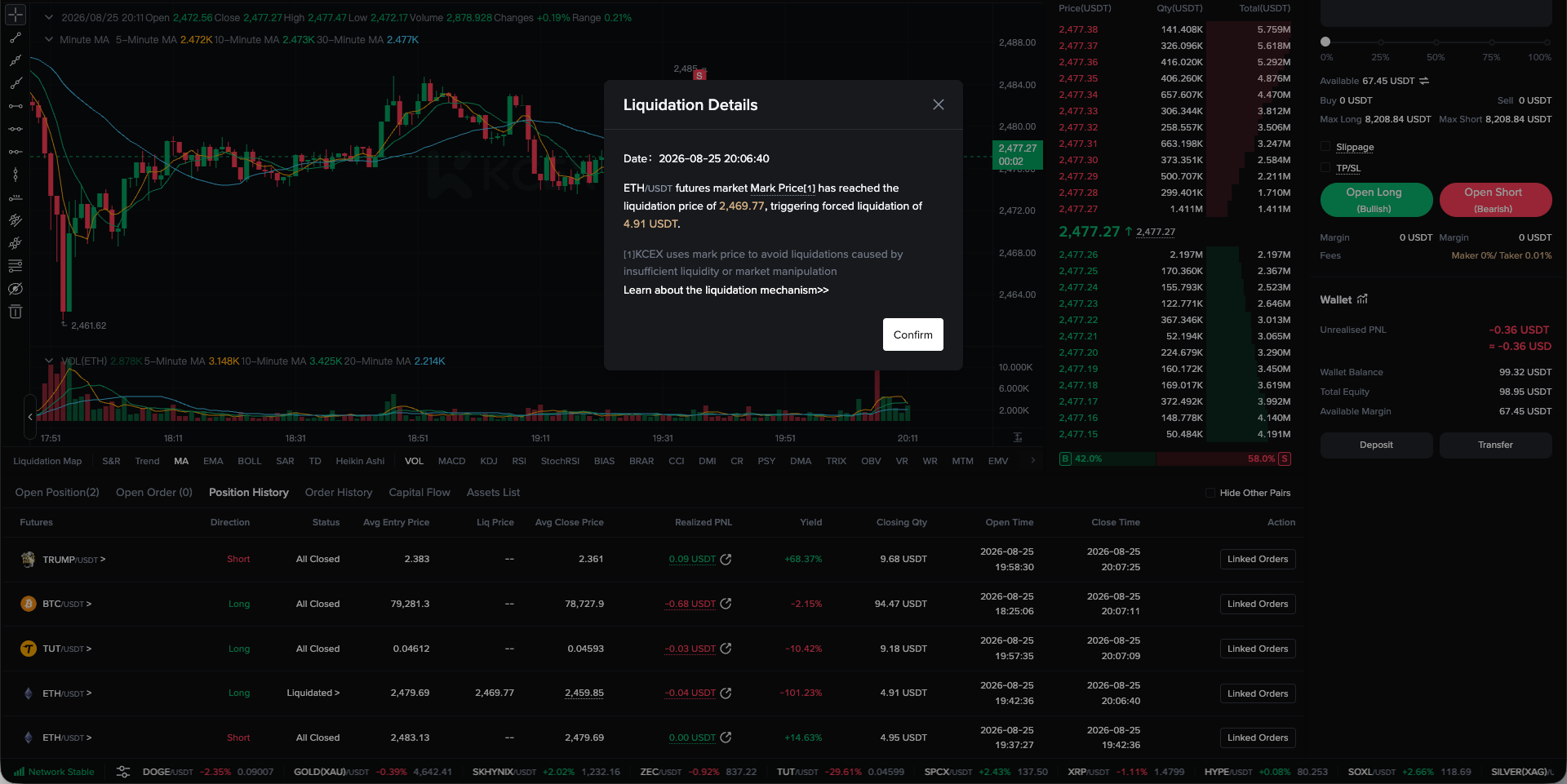
KCEX uses the Mark Price to determine whether liquidation should be triggered. The mark price is calculated based on both the index price and market price, providing a relatively fair and reasonable reference price. Using the mark price helps prevent liquidations caused by insufficient liquidity or market manipulation. Liquidation will be triggered when the mark price reaches the liquidation price.
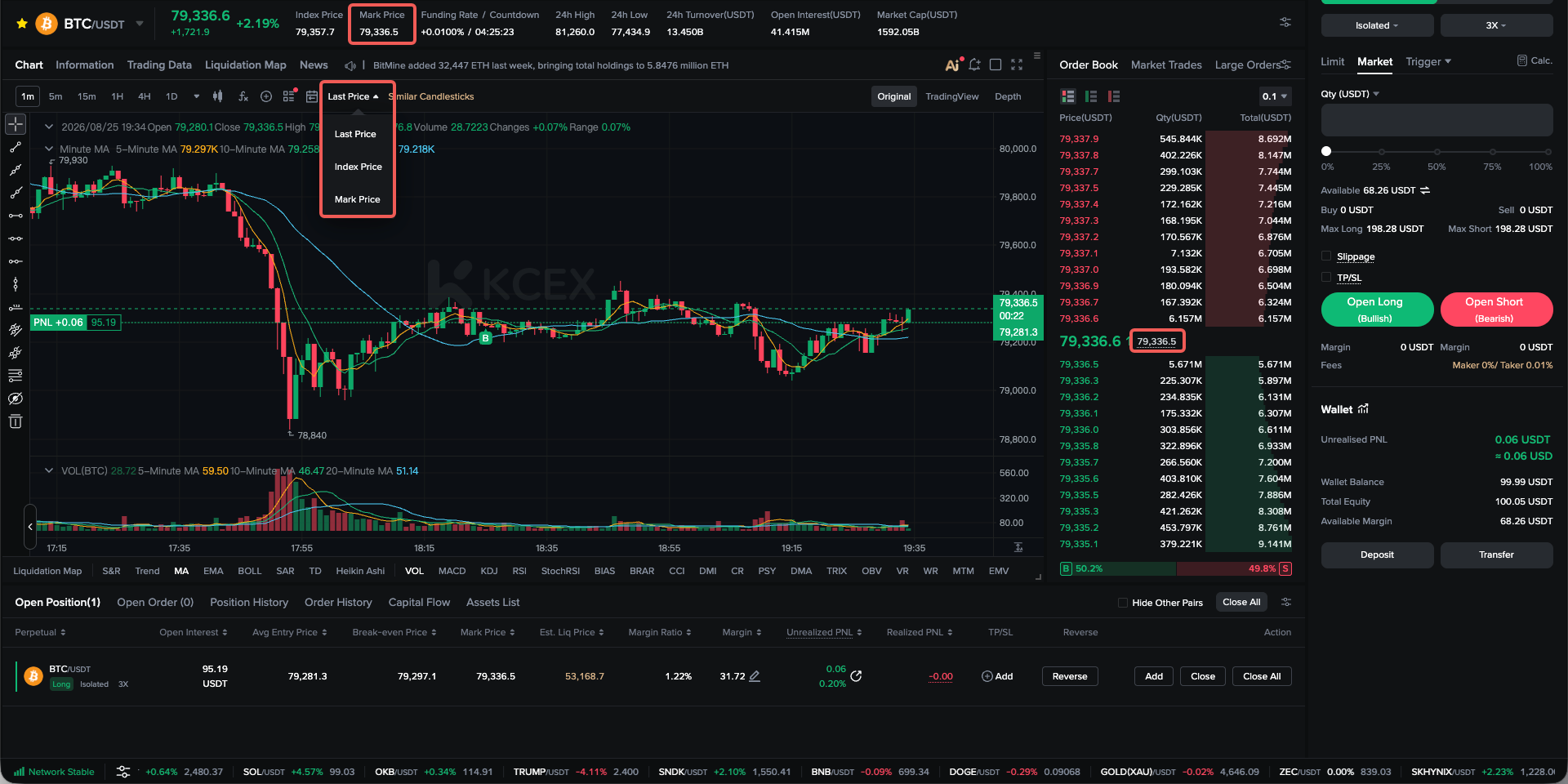
You can view the latest mark price on the KCEX website. You may also select Mark Price above the candlestick chart to view the mark price candlestick chart, allowing you to monitor your futures positions and market conditions more effectively.
3. How to View Liquidation Orders
You can view liquidation orders in the following two ways:
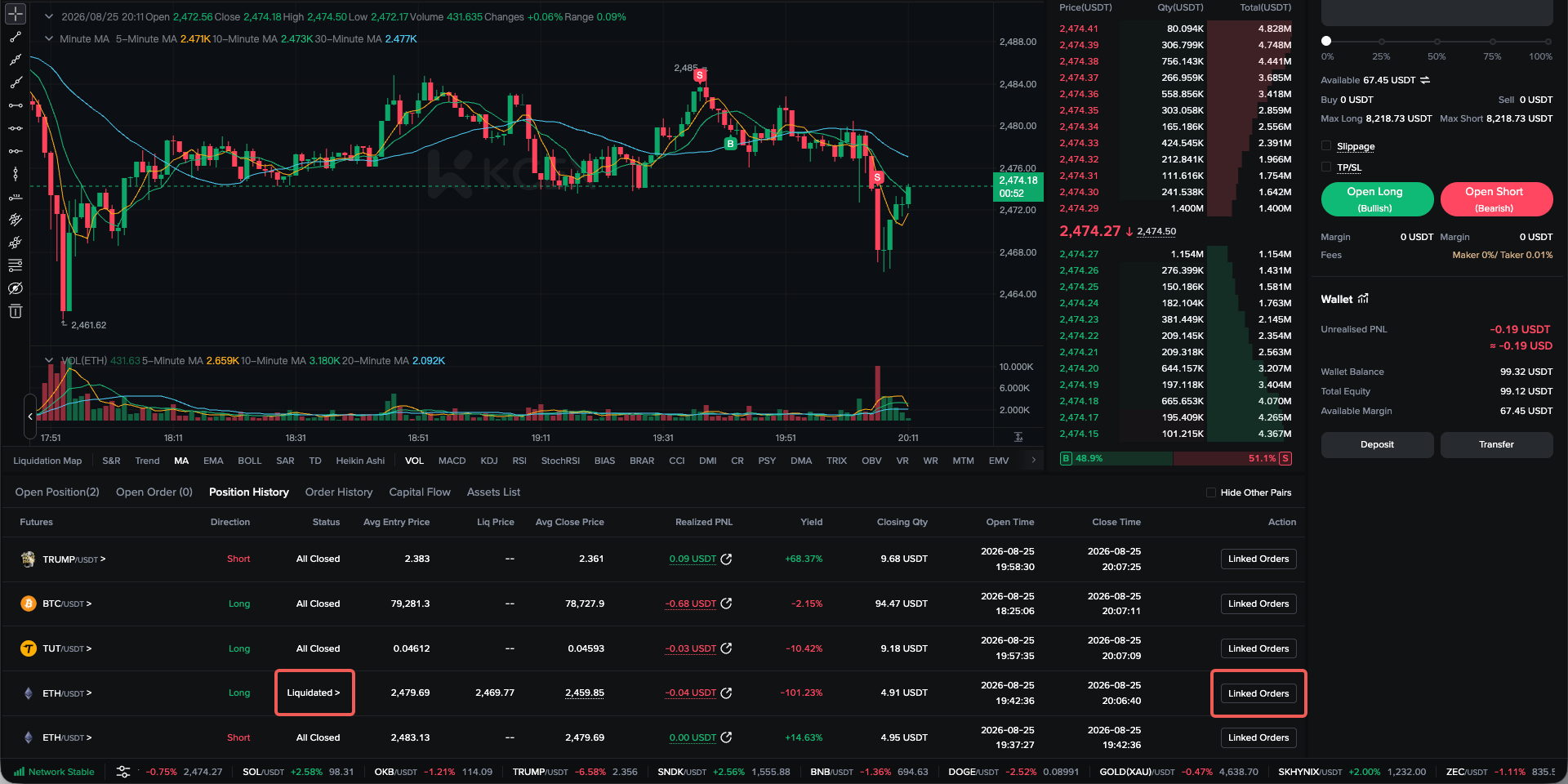
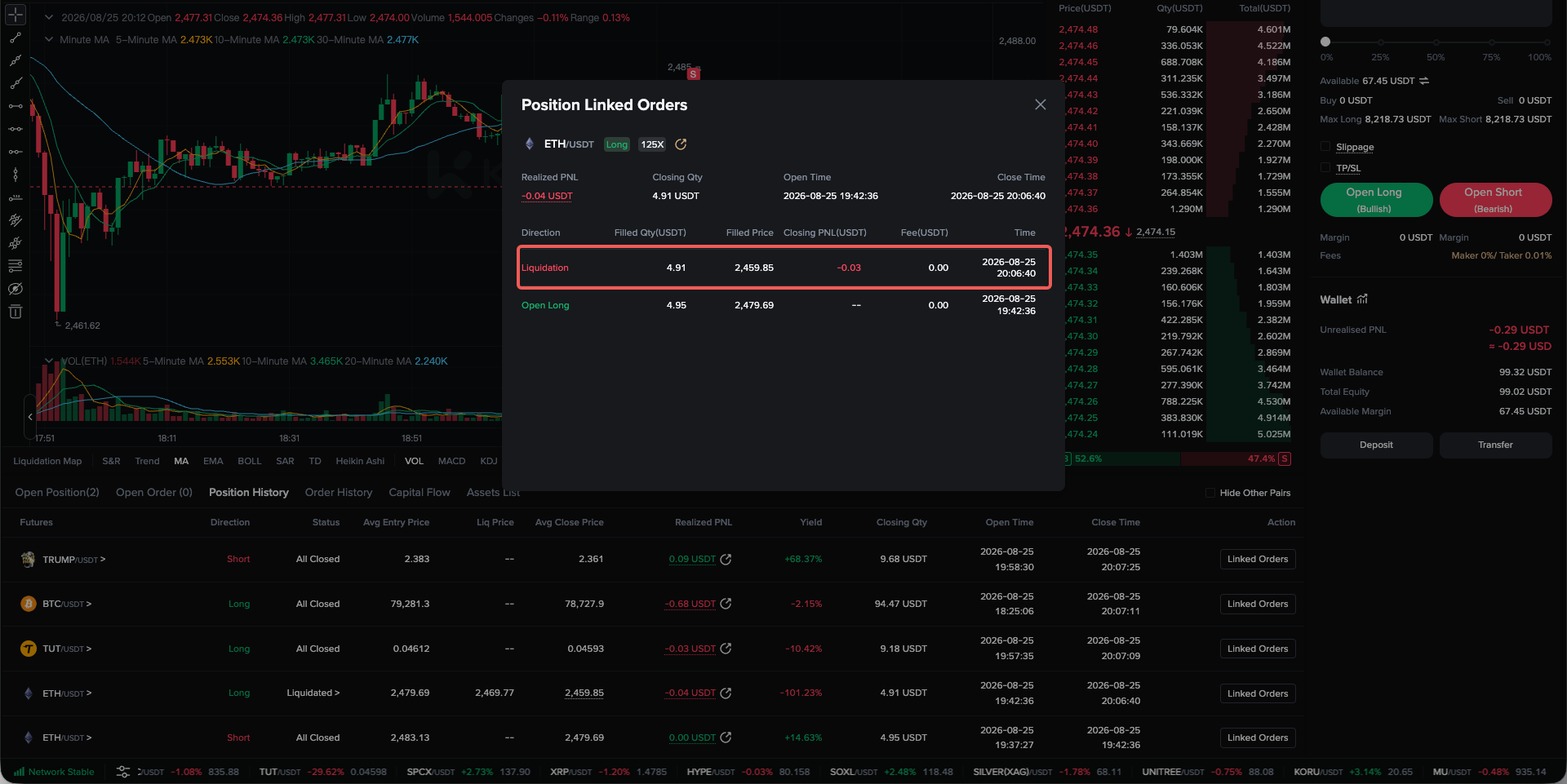
(1) Go to Position History and locate a position with the status Liquidated. Click the status to view the liquidation details. You can also find the liquidation order under Related Orders.
(2) Go to Order History and select Liquidation History to view the relevant records.
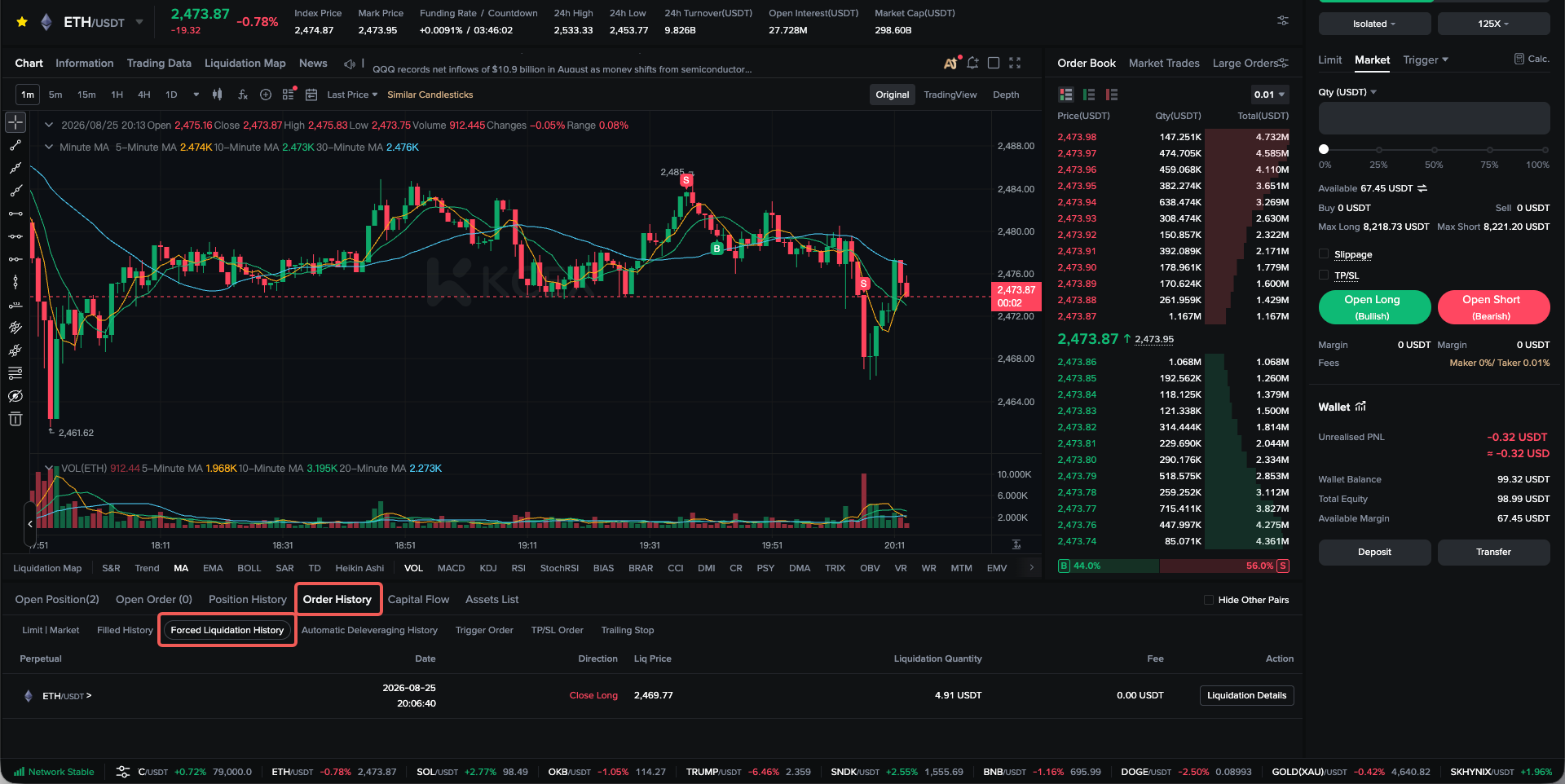
4. Relationship Between the Liquidation Price and Position Takeover Price
The liquidation price is not the same as the position takeover price. The liquidation price is the trigger price at which liquidation occurs. Once liquidation is triggered, the platform’s liquidation engine takes over the user’s position at the takeover price. The average closing price displayed under Position History is the position takeover price.
The position takeover price, also known as the bankruptcy price, is the calculated price at which all margin allocated to the position is completely depleted to zero.
Why is there a bankruptcy price?
The platform offers leverage, allowing users to increase their position size relative to their initial capital.
For example, with 10× leverage, 1 USDT can be used to open a position worth 10 USDT. However, the user’s actual margin is only 1 USDT. Theoretically, if the value of the 10 USDT position falls by 10% to 9 USDT, the user’s initial margin will be fully depleted.
If liquidation were triggered only after the user’s margin reached zero, closing the position—then worth 9 USDT—at the market price could result in proceeds of only 8 USDT or less due to market liquidity fluctuations, slippage, or other factors. This could result in a loss exceeding the position margin and create a deficit.
For this reason, the maintenance margin mechanism was introduced. Liquidation is triggered when the user’s margin falls to the maintenance margin level, rather than only after it reaches zero. Therefore, the price at which the position’s remaining margin falls to the maintenance margin level is the liquidation price, while the price at which the position margin is completely depleted is the bankruptcy price.
Example (excluding trading fees):
A user applies 100× leverage and uses 10 USDT in initial margin to open a long position of 1 ETH in the ETH/USDT perpetual futures at an entry price of 1,000 USDT. The position details are as follows:
| Leverage | Average Entry Price (USDT) | Position Margin (USDT) | Position Value (USDT) | Maintenance Margin Rate | Maintenance Margin (USDT) | Liquidation Price (USDT) | Bankruptcy Price (USDT) | |
| Long | 100X | 1000 | 10 | 1000 | 0.5% | 5 | 995 | 990 |
Maintenance Margin = Position Value × Maintenance Margin Rate = 5 USDT
In this example, the user holds 1 ETH with an average entry price of 1,000 USDT, while the initial margin is only 10 USDT and the maintenance margin is 5 USDT. If the ETH price falls from 1,000 USDT to 995 USDT, the user will incur a loss of 5 USDT, leaving only the required maintenance margin and triggering liquidation. Therefore, the liquidation price is 995 USDT.
If the ETH price reaches 990 USDT, the user’s entire initial margin will be depleted. Therefore, 990 USDT is the bankruptcy price.
Accordingly, when the ETH price falls to 995 USDT, the platform will take over the user’s position at the bankruptcy price of 990 USDT.
Note: After taking over the position at the bankruptcy price, the platform will close the position. If any of the position’s maintenance margin remains after the position is closed, the remaining amount will be transferred to the platform’s insurance fund. If the market experiences extreme volatility and the price moves rapidly in an unfavourable direction, the position’s maintenance margin may be insufficient to cover the resulting loss, creating a deficit. In this case, funds from the platform’s insurance fund will be used to cover the shortfall.
5. Changes in the Liquidation Price
The liquidation price of a futures position differs between cross-margin mode and isolated-margin mode.
In cross-margin mode, all available margin is used as position margin. If you hold multiple positions, unrealized P&L will affect their liquidation prices. If the unrealized P&L of one position increases, all positions will be less likely to be liquidated. Conversely, if the unrealized P&L of one position decreases, all positions will be more likely to be liquidated. In addition, changes in position size will also affect the liquidation price. If you hold multiple positions in cross-margin mode, it is recommended that you monitor the margin ratio to assess your overall risk.
In isolated-margin mode, the liquidation price will remain unchanged, provided that the average entry price remains unchanged and no additional positions or position margin are added. Even if you hold multiple isolated-margin positions, each position is independent and does not affect the others. Therefore, in isolated-margin mode, you can either monitor whether the mark price has reached the liquidation price or whether the margin ratio has reached 100%. Both can be used to assess liquidation risk.
Funding fees may also affect the liquidation price. In cross-margin mode, receiving or paying funding fees changes the margin balance and therefore affects the liquidation price. In isolated-margin mode, receiving funding fees does not change the liquidation price. However, if funding fees must be paid and the available margin is insufficient, the fees will be deducted from the position margin, causing the liquidation price to change.
Therefore, the liquidation price is affected by the margin mode, margin balance, and funding fee payments or receipts. You should take these differences into consideration when opening a position.
6. Reasons a Stop-Loss Order May Fail
When trading futures on KCEX, a stop-loss order may fail for various reasons:
(1) The stop-loss price is set too close to the liquidation price: If the stop-loss price is too close to, or less favourable than, the liquidation price, your position may be liquidated before the stop-loss order is triggered. Therefore, avoid setting the stop-loss price too close to the liquidation price.
(2) Extreme market volatility: During periods of significant market volatility, the market price may move rapidly past your specified stop-loss price, causing the order to remain unfilled or only partially filled.
(3) Other factors: Insufficient closable position size, the futures pair being unavailable for trading, or system issues may also cause a stop-loss order to fail.
Take-profit and stop-loss orders on KCEX are executed at the market price. Therefore, the execution price may differ from the trigger price. To reduce the risk of liquidation, you are advised to monitor your margin closely, use stop-loss orders appropriately, and consider adjusting your leverage.
KCEX remains committed to providing users with secure and efficient futures trading services. Thank you for your support!