

KCEX Spot Trading FAQ: Fees, Order Types, Trading Rules and Common Questions
2026-08-19 14:29:56
This article compiles frequently asked questions about KCEX spot trading, covering basic spot trading concepts, differences between spot and derivatives trading, spot trading fees, Maker and Taker, limit and market orders, order inquiries, differences between asset balance and available balance, as well as spot trading risks and precautions. Whether you're trading cryptocurrency spot for the first time or want to better understand KCEX spot trading rules, you can quickly find relevant answers here.
1. Basic Concepts of Spot Trading
1.1 What is spot trading?
Cryptocurrency spot trading refers to transactions where buyers and sellers trade at the current market price, exchanging one cryptocurrency for another. For example, in the BTC/USDT trading pair, a buyer can use USDT to purchase BTC, while a seller can sell BTC to receive USDT.
1.2 What is the difference between spot trading and derivatives (contract) trading?
There are significant differences between spot trading and derivatives (contract) trading in the cryptocurrency market. In spot trading, traders must own the underlying asset and trade at the current market price. In KCEX contract trading, parties do not directly exchange the actual asset; instead, they speculate on price movements by taking long or short positions to profit from price rises or falls. Users can leverage their capital in contract trading, but traders must post a certain amount of assets as margin.
Comparison | Spot Trading | Contract Trading |
Asset Ownership | Actually owns the corresponding asset | Only holds a contract; does not own the actual asset |
Settlement Method | Transaction occurs and is immediately settled with physical delivery | Settled by closing positions based on price fluctuations |
Leverage | No leverage | High leverage available |
Risk Level | Lower risk — only value fluctuations of the asset | Higher risk — liquidation risk exists; potential loss of all principal |
How to Profit | Asset appreciation | Profit from price differences by going long/short |
Holding Period | Unlimited | Unlimited, but positions may incur funding fees |
Applicable Scenarios | Suitable for long-term investment | Suitable for short-term trading |
1.3 What are KCEX spot trading fees?
KCEX is currently running "Lowest Fees in the Market: KCEX Launches Zero Trading Fee Event for Spot Trading" which charges zero spot trading fees.
1.4 What are Taker and Maker?
A "Maker" refers to an order that, when placed, does not immediately match an existing order and is added to the order book to wait for execution; it provides market liquidity.
A "Taker" refers to an order that immediately matches and executes against existing orders when placed; it takes liquidity from the market.
2. Spot Order Types
2.1 What order types are supported for spot trading?
KCEX spot trading currently supports limit orders, market orders, and take-profit/stop-loss orders (including one-way and two-way modes).
2.2 At what price does a market order execute?
A market order executes at the best available market price and does not require the user to input a specific price. In extreme situations, if the market is highly volatile, your large order might not be fully filled in one go. In that case, you can place the order again or use a limit order instead.
Also, KCEX allows users to set a slippage tolerance when using market orders — the maximum allowed slippage — to help ensure that the order does not suffer large losses due to excessive slippage.
3. Account and Funds
3.1 Why are my asset balance and available balance different?
When you initiate a withdrawal that hasn't completed yet, or when you place a spot order that remains unfilled, the corresponding funds are locked and cannot be used for trading, causing a difference between your asset balance and available balance.
Solution: You can check your balance after the withdrawal completes. Or, on the trading page, find "Current Orders" and cancel the related orders to release the locked funds.
3.2 Is there a minimum amount per trade?
Each trade has a minimum order amount. For the USDT markets, the minimum per trade is 1 USDT; for the USDC markets, the minimum per trade is 1 USDC.
4. Order Management
4.1 How do I view past orders?
(1) On the spot trading page, switch between "Open Orders" and "Order History / Trades" at the bottom to view.
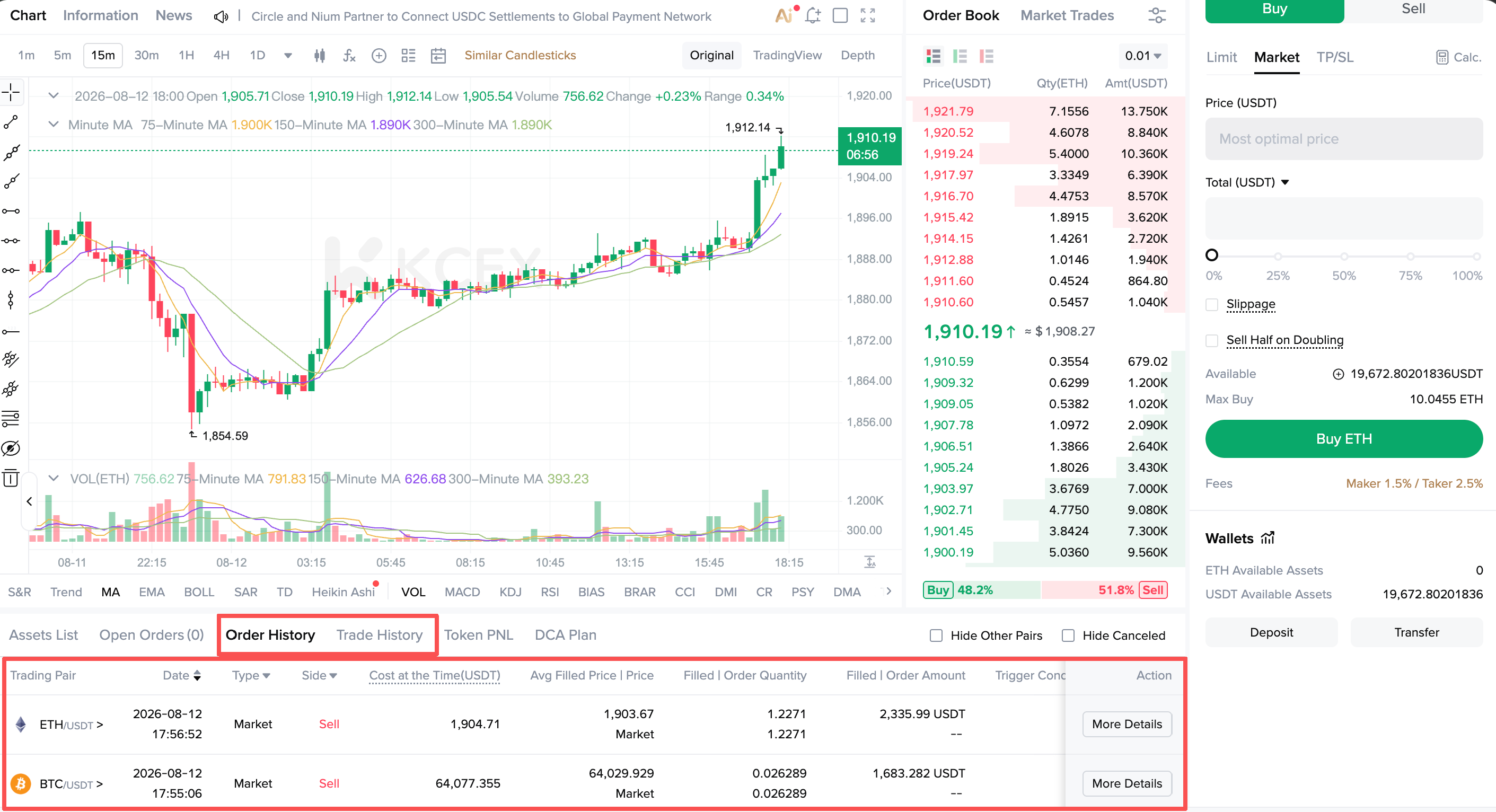
(2) You can also go to the menu's "Orders" and click "Spot Orders", then switch between "Open Orders" and "Order History / Trades" to view.
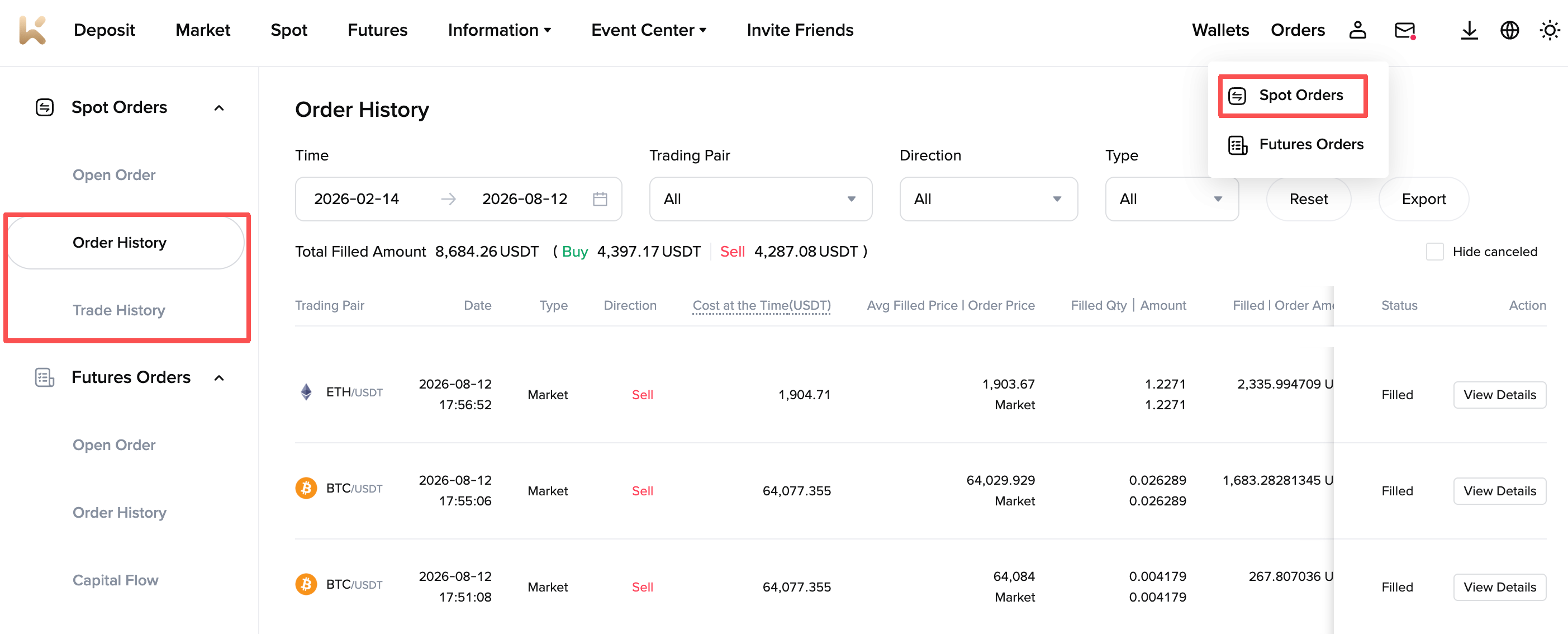
4.2 What is the difference between Current Orders, Order History, and Trade History?
- Current Orders: orders that are not yet completed and are currently on the order book waiting to be filled or triggered; they may still be filled or canceled later.
- Order History: orders that have already ended; they will not produce any new trades and are for viewing only with no further status changes.
- Trade History: records of executed trades, documenting the specific execution price, quantity, and time. A single order may correspond to multiple trade records (for example: a buy order A might match with sell orders B and C, resulting in two trade records—one for A & B and one for A & C).
5. Risk Notices and Trading Suggestions
5.1 What risks should be noted in spot trading?
- Market volatility risk: cryptocurrency prices can be highly volatile and may lead to significant loss of asset value.
- Liquidity risk: small-cap tokens may face insufficient liquidity, making it hard to sell at reasonable prices and forcing losses.
- Project risk: small-cap tokens may be delisted, leading to inability to trade and only allowing withdrawals.
- Operational risk: incorrect price settings or account management errors may cause losses.
5.2 What suggestions are there for beginners trading spot?
- Start small: use a small amount of funds to get familiar with platform operations and order mechanics.
- Prefer mainstream coins: choose mainstream assets like BTC and ETH that have good liquidity and relatively lower volatility.
- Use limit orders: avoid market order slippage risk and better control the execution price.
- Set stop-loss: use take-profit and stop-loss orders to manage risk and protect funds.
- Diversify investments: do not put all funds into a single asset.
- Keep learning: follow market developments and continually improve trading skills.
KCEX is always committed to providing users with a secure and efficient derivatives trading service. Thank you for your support!