


Bitcoin price fell below $64,000 on July 31 as renewed U.S.–Iran tensions lifted oil prices and strengthened the dollar, while its 4-hour chart formed a bearish rounded-top structure.
- Bitcoin price fell as low as $62,466, extending its rejection from the $65,000 area.
- A rounded-top breakdown points toward $59,000 if support near $62,000 fails.
- Iran reportedly attacked two tankers under U.S. escort in the Strait of Hormuz.
- Oversold momentum and concentrated liquidity near $62,000 could produce a short-term rebound.
Bitcoin price falls below key moving averages
According to data from crypto.news, Bitcoin (BTC) price dropped as much as 3.6% from its intraday high on Friday, sliding from $65,410 to a low of $62,466. It was trading near $63,155 at the time of the daily-chart snapshot, down 2.5% for the session.
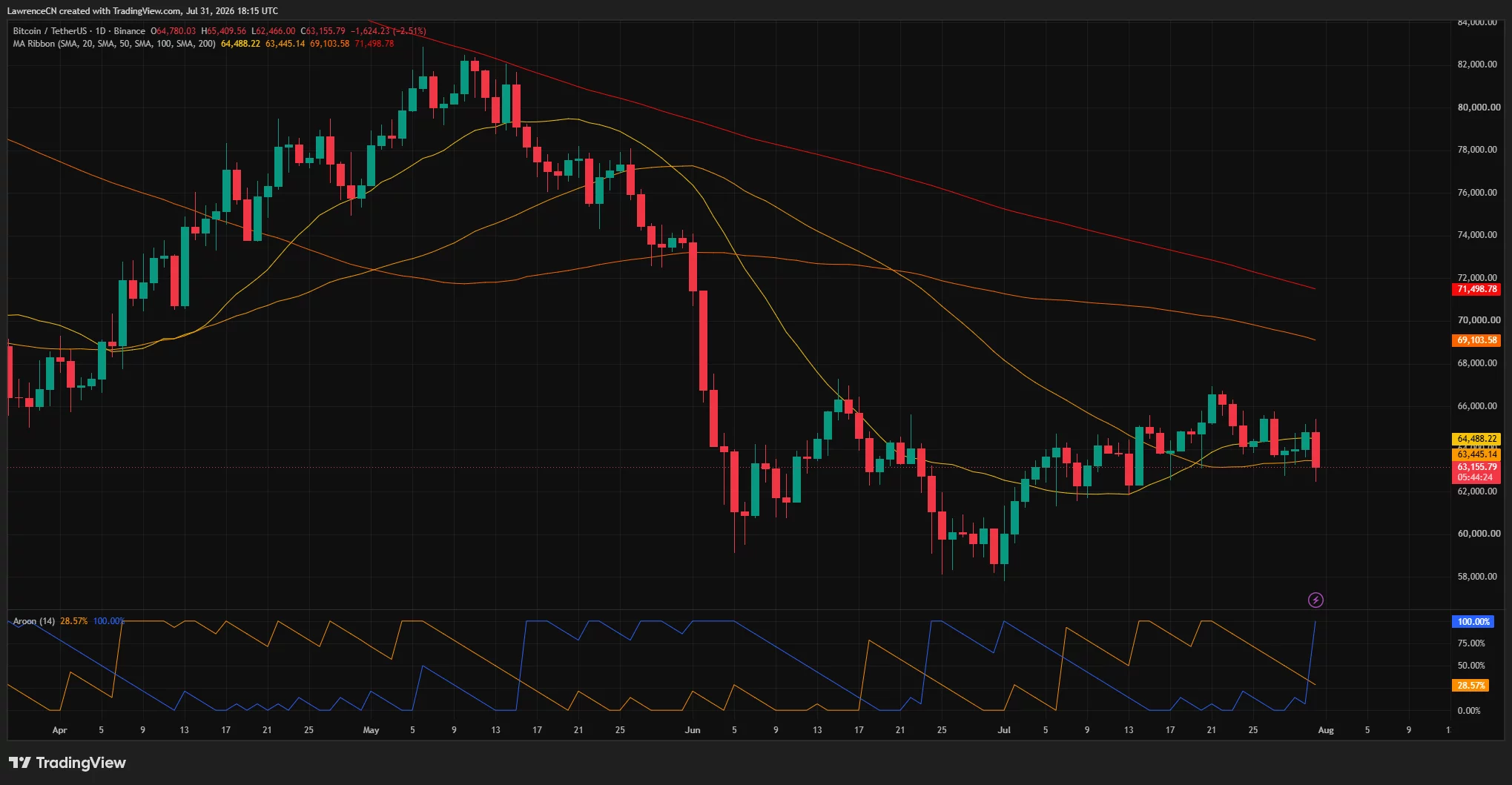
The decline pushed Bitcoin below its seven-day and 25-day simple moving averages at approximately $63,445 and $64,488. Losing both levels indicates that short-term sellers have regained control after BTC failed to sustain its July recovery.
Bitcoin also remains far below the 50-day SMA at $69,104 and the 200-day SMA near $71,499. These averages represent major overhead resistance and reinforce the wider bearish structure that has remained in place since the asset fell from above $82,000 in May.
The daily Aroon indicator supports the bearish reading. Aroon Down jumped to 100%, while Aroon Up stood at 28.57%, showing that the latest low occurred much more recently than the last meaningful high.
However, Bitcoin has not yet broken the broader range between approximately $58,000 and $67,000. Sellers would need to force a sustained move below $62,000 to expose the lower end of that structure.
Iran escalation adds to risk-off pressure
Bitcoin’s latest decline coincided with another escalation in the U.S.–Iran conflict and renewed concerns about energy supplies passing through the Strait of Hormuz.
Iran said it attacked two oil tankers attempting to cross the waterway under U.S. military escort. Tehran also claimed it turned back four other vessels, while ship-tracking data showed that traffic through the strait remained thin.
The development carries greater market risk than an isolated attack on commercial vessels because the presence of a U.S. escort raises the possibility of a direct military response.
Iran separately launched drone attacks targeting U.S.-linked military facilities in Kuwait and Bahrain. Kuwait said it intercepted the drones and reported no casualties.
President Donald Trump also convened his Cabinet at Camp David as the administration considered its next steps in the conflict. No new military operation was formally announced during the meeting.
Meanwhile, the U.S. Senate failed in a 49–50 vote to advance a measure restricting Trump’s authority to continue hostilities. The result left the administration’s short-term military options largely unchanged.
These developments lifted oil prices and renewed concerns that higher energy costs could keep U.S. inflation elevated. A stronger dollar and rising Treasury yields added pressure on Bitcoin and other non-yielding risk assets.
The reported U.S.–Israeli proposal for a land blockade of Iran remains an option under discussion rather than an announced policy. It would reportedly involve persuading neighboring countries to restrict Iranian imports and exports.
Bitcoin rounded top targets $59,000
Bitcoin’s 4-hour chart shows a rounded-top formation developing since late June. BTC climbed from approximately $59,000 to a July 22 peak near $66,700 before forming a gradual series of lower highs.
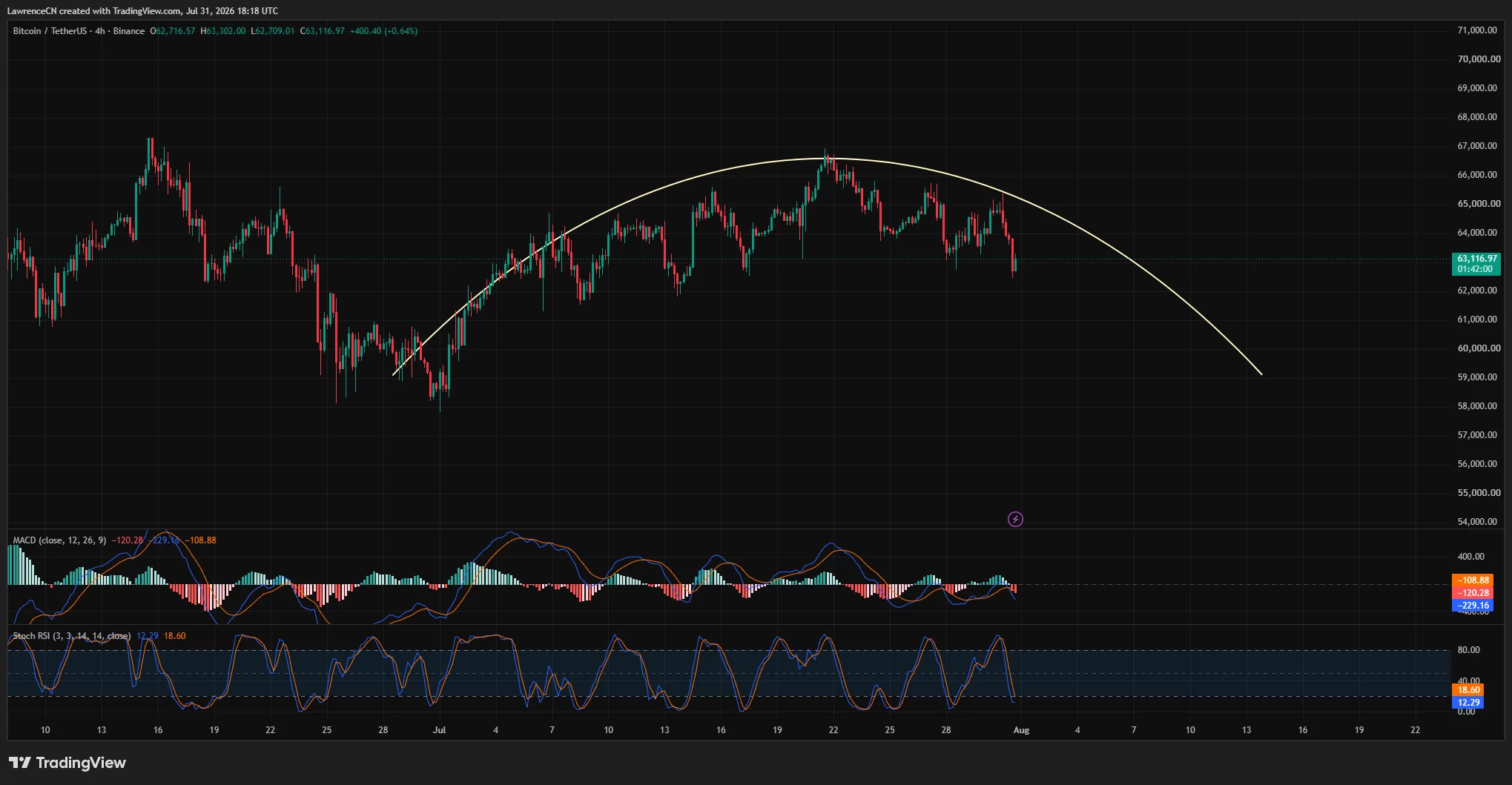
The latest rejection from around $65,000 pushed the price toward the pattern’s neckline between $62,000 and $63,000. A confirmed 4-hour close below that area could validate the breakdown and place $59,000 back in focus.
Momentum indicators currently favor sellers. The 4-hour MACD line fell to approximately minus 229, below its signal line near minus 109. The negative histogram widened to around minus 120, showing that bearish momentum accelerated during the latest decline.
Still, the Stochastic RSI has reached oversold territory. Its two lines stood at 12.29 and 18.60, both below the 20 threshold. That reading does not guarantee an immediate recovery, but it suggests that the sell-off may be becoming stretched over the short term.
Bitcoin may therefore retest the broken $63,400–$64,500 area before deciding its next direction. Reclaiming $64,500 would weaken the immediate bearish setup, while a move above $65,500 would challenge the rounded-top structure.
Liquidity near $62K could trigger a reversal
Trader Ted Pillows identified another possible downside target using Bitcoin’s liquidation map. He said the decline had already cleared much of the liquidity beneath the previous trading range, leaving a remaining concentration close to $62,000.
“There’s still one cluster around the $62,000 level, which might be next. But after that, a reversal might happen.”
The $62,000 area aligns with the rounded top’s neckline and several recent intraday lows, making it the most important near-term level.
A sweep below that support could trigger leveraged long liquidations before buyers attempt a recovery. Failure to attract demand would instead open the path toward $60,000 and the rounded-top objective near $59,000.
On the upside, Bitcoin must first reclaim $63,445 and $64,488. Stronger resistance sits between $65,000 and $66,700, where several July rallies stalled.
Geopolitical headlines remain the immediate external risk. Further attacks involving U.S. forces, tankers, or major shipping routes could lift oil and extend the risk-off move. Conversely, evidence of negotiations or safer passage through Hormuz could ease inflation concerns and help Bitcoin stabilize.
Disclosure: This article does not represent investment advice. The content and materials featured on this page are for educational purposes only.