

KCEX Mark Price Guide: Calculation Method, Functions, and Differences From the Latest Traded Price
2026-08-26 11:35:31
The mark price is an important reference price used to assess position risk in perpetual futures trading. It is primarily used to determine liquidation and calculate unrealized P&L. The mark price is not necessarily the same as the latest traded price, as its calculation incorporates factors such as the index price, funding rate, order book prices, and latest traded price. This article explains the meaning and calculation of the KCEX mark price, how to view it, and its role in liquidation and unrealized P&L calculations, helping you better understand the pricing mechanism and risk management rules of perpetual futures.
1. What Is the Mark Price?
The mark price is calculated using a combination of the index price, funding rate, order book prices, and latest traded price. It more accurately reflects the fair value of the futures and is an important pricing mechanism designed to maintain market stability and reduce unnecessary liquidations during abnormal market volatility.
The mark price is primarily used to determine liquidation and calculate unrealized P&L. It helps prevent unnecessary deviations between the market price and index price caused by market manipulation or insufficient liquidity, thereby reducing unnecessary liquidations. The mark price is a core risk control mechanism designed by KCEX to protect traders.
2. Mark Price Calculation
Mark Price Formula:
Mark Price = Median (Funding Rate Premium, Mid-Price Basis Fair Price, Latest Traded Price)
Where:
- Funding Rate Premium = Index Price × [1 + Latest Funding Rate × (Time Until the Next Funding Settlement ÷ Funding Rate Settlement Interval)]
- Mid-Price Basis Fair Price = Index Price + Moving Average of the Basis (Specified Period) = Index Price + Moving Average [((Best Bid Price + Best Ask Price) ÷ 2) − Index Price]
- Latest Traded Price = Latest Traded Price of the Futures
3. How to View the Mark Price
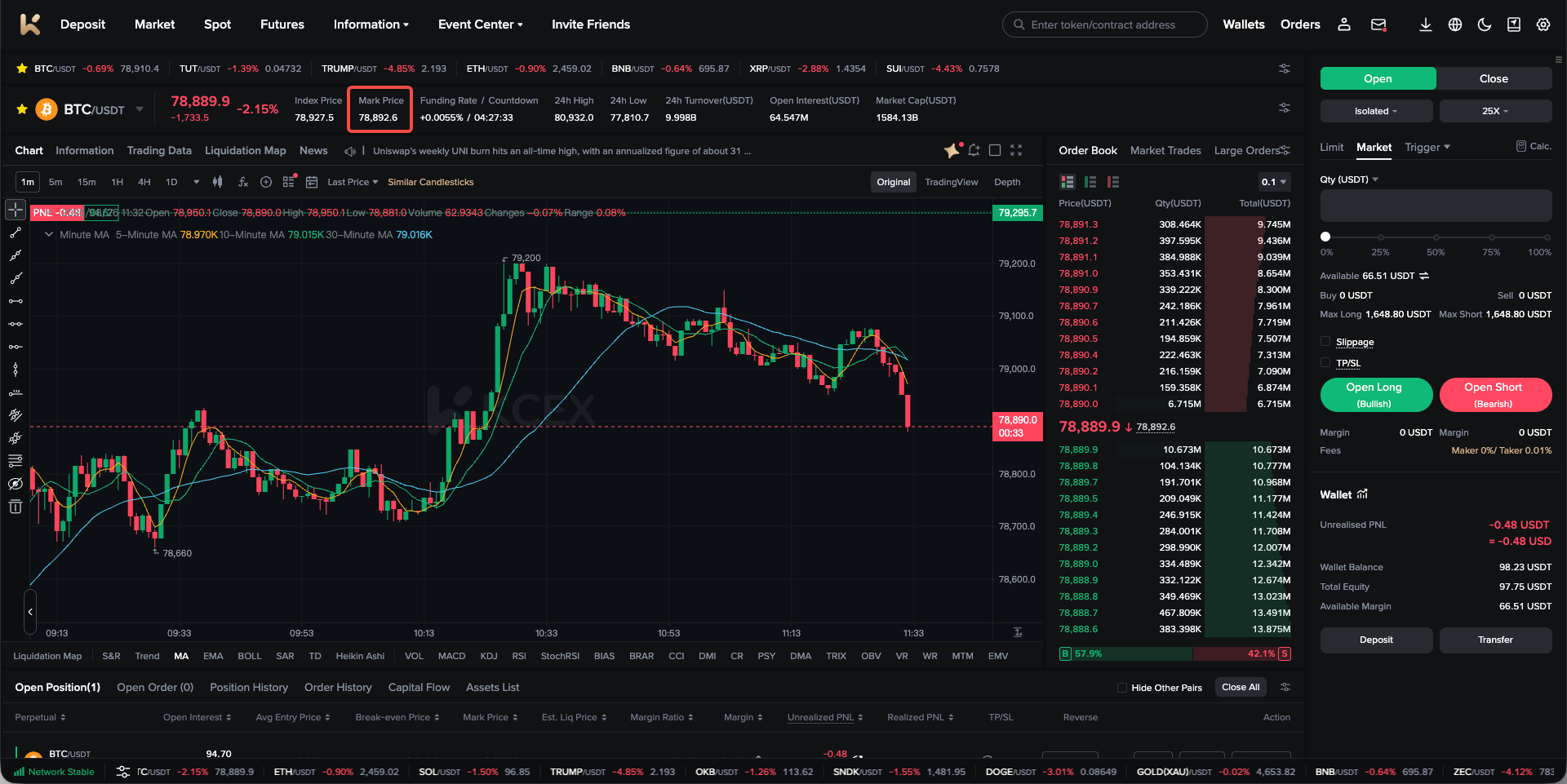
(1) View the Mark Price You can view the latest mark price of the current futures directly in the Market Overview section of the futures trading page. You can also view the latest mark price next to the Latest Price in the order book.
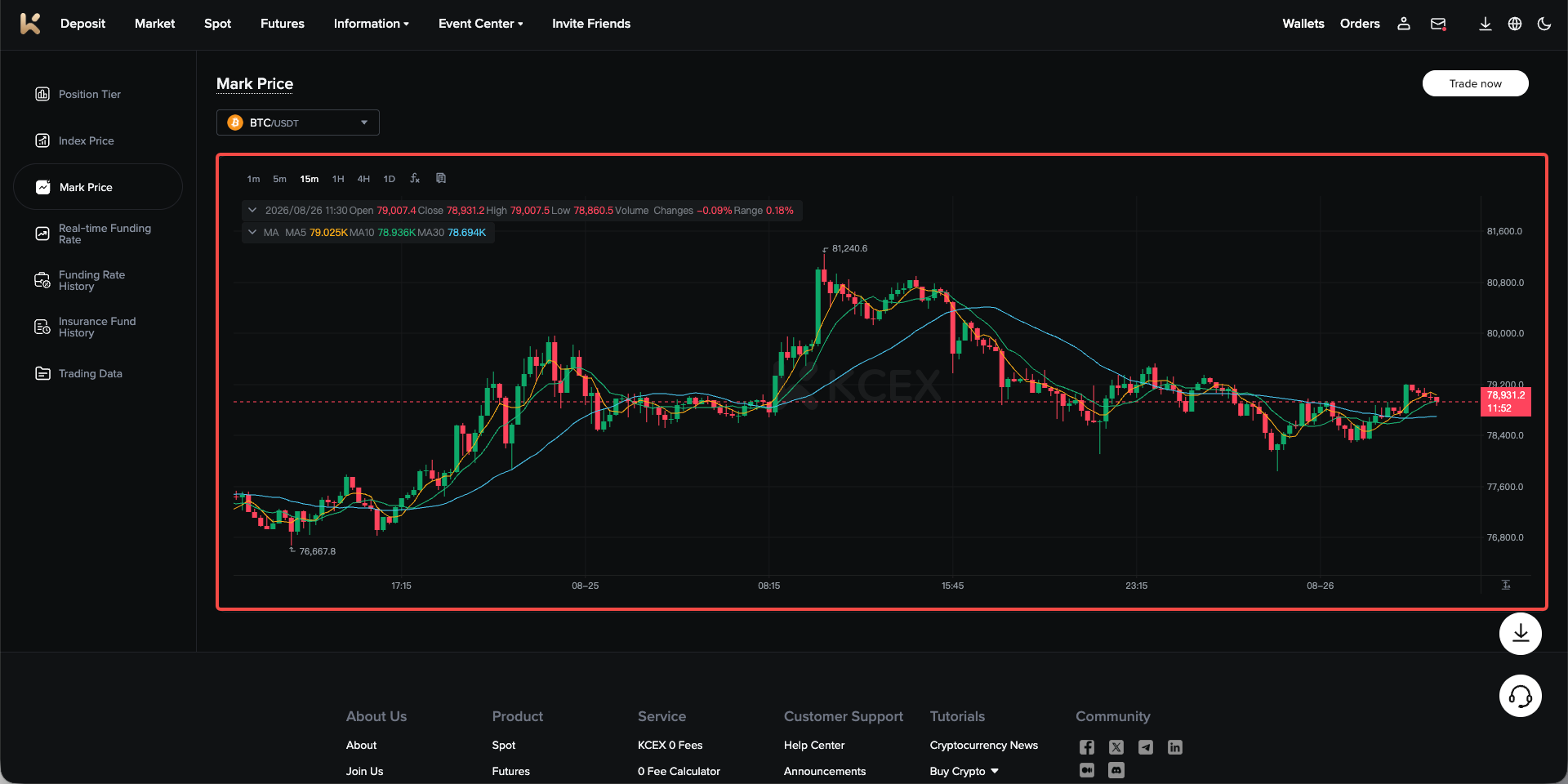
(2) View Mark Price Candlestick Data Go to Futures Information > Mark Price from the menu bar to access the Mark Price page. Search for the relevant trading pair to view its mark price candlestick data.
4. Functions and Important Notes of the Mark Price
(1) Functions of the Mark Price
The mark price is primarily used to determine whether a position should be liquidated and to calculate unrealized P&L. It does not affect realized P&L. When the market’s mark price reaches the estimated liquidation price of your position, liquidation will be triggered.
(2) Important Notes
Please note that the mark price is not the same as the latest traded price. The mark price is calculated using a comprehensive algorithm. During periods of significant market volatility, the latest traded price may deviate from the mark price, which may result in the following situations:
- Unrealized P&L may appear immediately after an order is filled.
- A position has a stop-loss order that uses the latest traded price as its trigger price. Although the stop-loss price is more favourable than the liquidation price, the two prices are very close. In this case, liquidation may be triggered before the stop-loss order.
You are therefore advised to closely monitor the difference between the estimated liquidation price and the mark price and assess the associated risks. When setting a TP/SL order, avoid placing the stop-loss price too close to the estimated liquidation price to prevent liquidation from being triggered before the stop-loss order.
KCEX remains committed to providing users with secure and efficient futures trading services. Thank you for your support!