

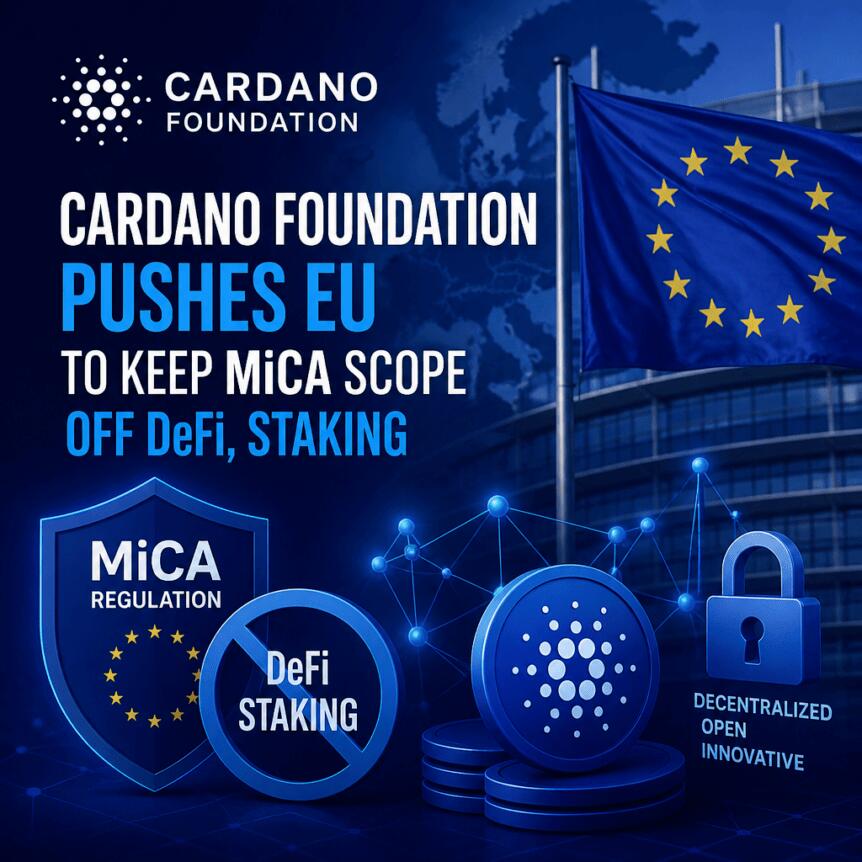
The Cardano Foundation has urged the European Union to resist creating brand-new, standalone rules specifically for decentralized finance (DeFi) and staking. In a detailed response submitted to the European Commission, the organization argues that existing financial regulatory frameworks should be applied based on what an activity does and the risks it creates—rather than on the underlying technology used to perform it.
In a Wednesday blog post, the foundation outlined its 19-page submission dated Sept. 30, calling for a clearer regulatory split between users who directly participate in decentralized networks and the financial services offered by intermediaries—especially where users’ assets are held, controlled, or otherwise custody-like arrangements are involved.
Key takeaways
- The Cardano Foundation wants EU regulation to track the substance and risk of an activity, not the technology label attached to it.
- It argues that delegation by users to help secure a network should not be treated the same as intermediary staking services that control assets.
- The foundation warns that unclear overlaps between MiCA and existing financial laws could produce inconsistent interpretations across EU member states.
- Its position arrives as EU regulators consider expanding oversight for staking, lending and borrowing, and potentially adding a regulated category for access to DeFi protocols.
Substance over technology in EU DeFi and staking rules
At the center of the foundation’s argument is a principle that EU regulation should follow “the substance of an activity, the functions performed, and the risks created, not the technology through which it is conducted.” That framing is intended to prevent blanket rules that could capture fundamentally different behaviors under a single regulatory bucket.
In its response, the foundation draws a line between two patterns of participation:
- Direct network participation, where users interact with a decentralized system in a way that does not require giving up custody or locking their tokens in a custody-like arrangement.
- Financial services provided by intermediaries, where the operational model involves control mechanisms—particularly those tied to custody or management of user assets.
The implication for market participants is straightforward: rules should be calibrated to whether an intermediary performs a finance-like role. Otherwise, the foundation suggests, compliant DeFi participation could be treated like a custodial or asset-management service, raising legal uncertainty and potentially limiting legitimate decentralized access.
Delegating ADA as participation—not custody
The foundation points specifically to Cardano users’ ability to delegate native ADA tokens to help secure the network. It argues that this delegation model allows participation without surrendering custody or permanently locking tokens in a way that resembles intermediary-managed staking.
By characterizing user delegation as fundamentally different from intermediary-run staking services, the foundation is effectively asking regulators to consider control and custody as the key regulatory differentiators. For investors and users, this matters because regulatory treatment can influence how products are designed, what terms intermediaries impose, and what compliance obligations are triggered—especially in markets where firms may be hesitant to offer services without clear guidance.
For builders, the same distinction could affect how decentralized applications are architected—particularly whether they route user assets through intermediary custody solutions or allow users to participate through mechanisms that preserve control.
MiCA overlap concerns as EU considers more staking oversight
The foundation’s submission also emphasizes the need for regulatory clarity between the EU’s Markets in Crypto Assets Regulation (MiCA) and existing financial laws. It warns that overlapping requirements, along with inconsistent interpretations across EU member states, could “create uncertainty” for crypto businesses.
That uncertainty is not merely theoretical. In practice, inconsistent approaches can lead to fragmented compliance strategies, higher operating costs, and uncertainty over which regulatory regime applies to a given service. The foundation’s argument suggests that without a careful delineation, firms could face contradictory obligations depending on where they market or operate.
The timing of the Cardano Foundation’s response is notable. EU regulators are already weighing additional safeguards and potential expansions to oversight for crypto activities. According to earlier reporting, the European Securities and Markets Authority (ESMA) recommended changes in September, including additional safeguards for staking, lending and borrowing, and proposed a new regulated service category for firms providing access to DeFi protocols.
Placed against that backdrop, the foundation’s call for substance-based regulation can be read as an attempt to influence how any additional safeguards are framed—so that the rules target real custody and intermediary risk rather than decentralized participation itself.
Regulatory clarity push extends beyond Europe
The Cardano Foundation’s EU advocacy also aligns with broader efforts for clearer crypto rules internationally. Earlier coverage from Cointelegraph noted that the Cardano Foundation joined five other blockchain organizations in an Oct. 20 letter urging the US Securities and Exchange Commission (SEC) to formally recognize digital commodities as non-securities under the SEC’s proposed crypto framework.
While that US request is separate from the EU discussion, both campaigns share a common theme: regulators should provide clearer boundaries that distinguish activity types and reduce ambiguity for market participants.
For users, builders, and exchanges, clarity matters because it directly affects which services can be offered, how they can be offered, and how compliance programs should be structured. For decentralized networks, it also matters whether regulators treat decentralization itself as a risk factor—or whether they focus on custody, control, and financial intermediation.
As EU discussions move forward, the key question for the industry is whether regulators will adopt the Cardano Foundation’s substance-and-risk approach—especially around delegation versus custodial staking, and MiCA versus existing financial law overlaps—or whether they will pursue more prescriptive rules aimed specifically at DeFi and staking. Market participants should watch for how ESMA’s recommendations and any subsequent EU drafting translate into concrete obligations for firms operating near decentralized ecosystems.
This article was originally published as Cardano Foundation Pushes EU to Keep MiCA Scope Off DeFi, Staking on Crypto Breaking News – your trusted source for crypto news, Bitcoin news, and blockchain updates.