

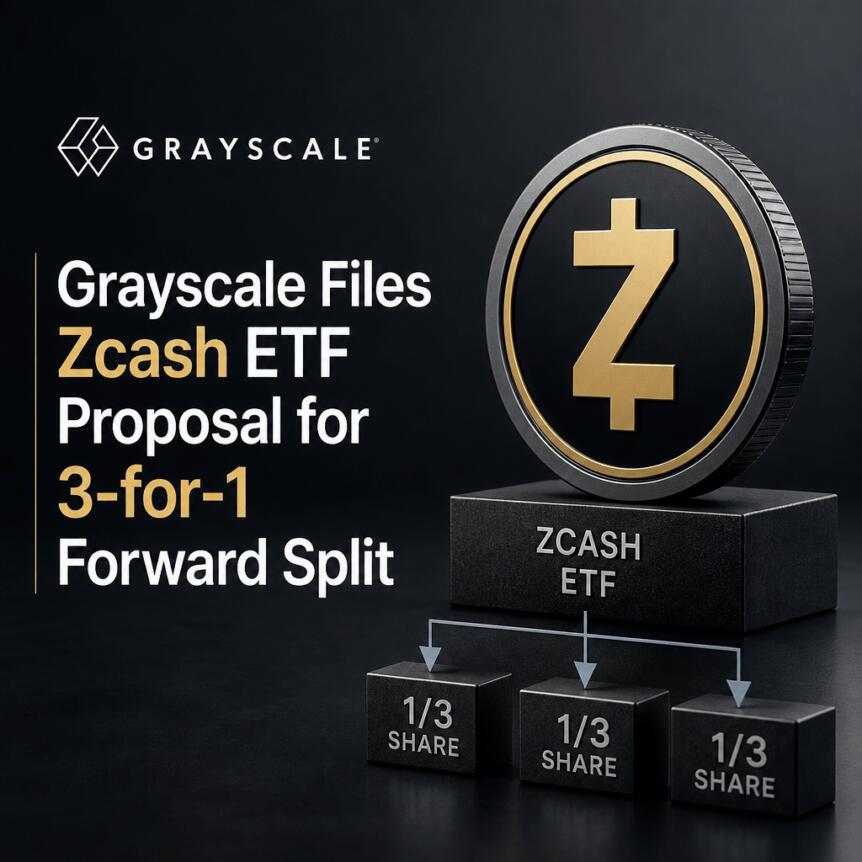
Grayscale’s spot Zcash ETF has filed plans with the U.S. Securities and Exchange Commission for a 3-for-1 forward share split, a move designed to lower the fund’s quoted price per share while keeping the overall value of an investment unchanged.
According to the filing referenced by Grayscale, shareholders of Grayscale’s Zcash ETF (ZCSH) would receive two additional shares for every share they hold after trading closes on Sept. 28. The change is expected to increase the number of shares outstanding proportionately and reduce the price per share accordingly.
Key takeaways
- Grayscale’s Zcash ETF (ZCSH) has filed for a 3-for-1 forward split with the SEC, with a Sept. 28 record timing after market close.
- The split is structured to keep investment value the same while reducing the fund’s per-share price through a proportional increase in shares.
- Grayscale says the action is intended to make the ETF more accessible, amid a sharp rise in Zcash’s value over the past year.
- Zcash-related news flow continues alongside the corporate action, including recent market moves tied to disclosed ZEC buying by Paradigm co-founder Matt Huang.
What Grayscale is changing in ZCSH
In the ETF filing, Grayscale outlines a forward split that would redistribute shares to current holders on the specified date. The forward split mechanism means the new share count is applied automatically based on existing holdings, rather than requiring holders to take any action.
Grayscale’s accompanying explanation, as cited in the filing and press materials, emphasizes that the split should not alter an investor’s economic position. The fund’s market value would remain the same, but each share would represent a smaller fraction of that value. In Grayscale’s illustrative example, an investor holding 10 shares valued at $300 each (for $3,000 total) would end up with 30 shares valued at $100 each—again totaling $3,000.
Grayscale also frames the change as an accessibility improvement. With the fund’s per-unit price potentially viewed as too high following Zcash’s strong performance, reducing the share price can make it easier for retail and smaller institutional investors to enter positions without needing to buy higher-priced units.
Why a forward split matters for ETF investors
Share splits are often operationally simple, but they can have practical implications for how investors engage with funds. While splits do not create or remove value by themselves, a lower quoted price per share can improve usability—particularly for investors using set dollar amounts rather than specific share quantities.
In markets that have seen high asset appreciation, per-share prices can rise quickly, sometimes shifting the balance between investors who can buy a single share versus those who require fractional trading or larger allocations. In that sense, Grayscale’s stated goal—greater accessibility—directly links the corporate action to the ETF’s recent performance context.
That context is significant here: the filing materials referenced by Grayscale indicate that Zcash has increased by about 2,800% over the past year. When an underlying holding—and by extension the ETF—rallies sharply, the fund’s share price can follow, even if the number of shares outstanding changes only through actions like splits.
Zcash moves in parallel: adoption narratives and market attention
Zcash’s renewed visibility in broader crypto markets has also been supported by recent commentary from prominent investors. Earlier coverage referenced by the article notes that Zcash (ZEC), known for enabling shielded transactions that conceal transaction addresses and amounts using zero-knowledge proofs, gained roughly 20% over a 24-hour period. That move was tied to disclosure by Paradigm co-founder Matt Huang that Paradigm made an unspecified purchase of ZEC.
Huang characterized Zcash as a “private complement to Bitcoin,” positioning privacy-focused digital assets as part of a broader ecosystem rather than a replacement. He also argued for continued long-term funding for Zcash’s development, citing the pace at which AI-enabled cyber capabilities and quantum computing progress could affect the security landscape.
As reported by The Block, ZEC traded as high as $1,521 early Friday before giving back some gains. The report described that level as a new effective all-time high, underscoring how quickly attention can return to assets when catalysts—whether investor flows, infrastructure expectations, or regulatory milestones—align.
For investors evaluating Grayscale’s ZCSH, the timing matters: a corporate action aimed at improving affordability and trading access arrives while Zcash is drawing active market interest. Even though a split itself doesn’t change fundamentals, it can affect day-to-day trading behavior and positioning, especially for investors who track price levels and use automated or discretionary allocation rules.
What to watch next after the SEC filing
Grayscale’s SEC filing sets out the split framework, including the forward split ratio and the share delivery timing tied to the close of trading on Sept. 28. The next key question for market participants is whether the planned schedule proceeds as described and whether the ETF’s share trading begins reflecting the new share count according to the expected timeline.
More broadly, investors should watch how ZCSH trades around the implementation—particularly whether the lower per-share price influences liquidity and investor participation. In parallel, attention on Zcash’s ecosystem—its privacy features backed by zero-knowledge proofs, and its development funding narrative—may continue to shape sentiment during the period leading up to the split.
With the split intended to make the ETF more accessible amid a period of strong performance for the underlying asset, market participants will likely focus on execution details and on whether Zcash’s momentum persists after the corporate action takes effect.
This article was originally published as Grayscale Files Zcash ETF Proposal for 3-for-1 Forward Split on Crypto Breaking News – your trusted source for crypto news, Bitcoin news, and blockchain updates.